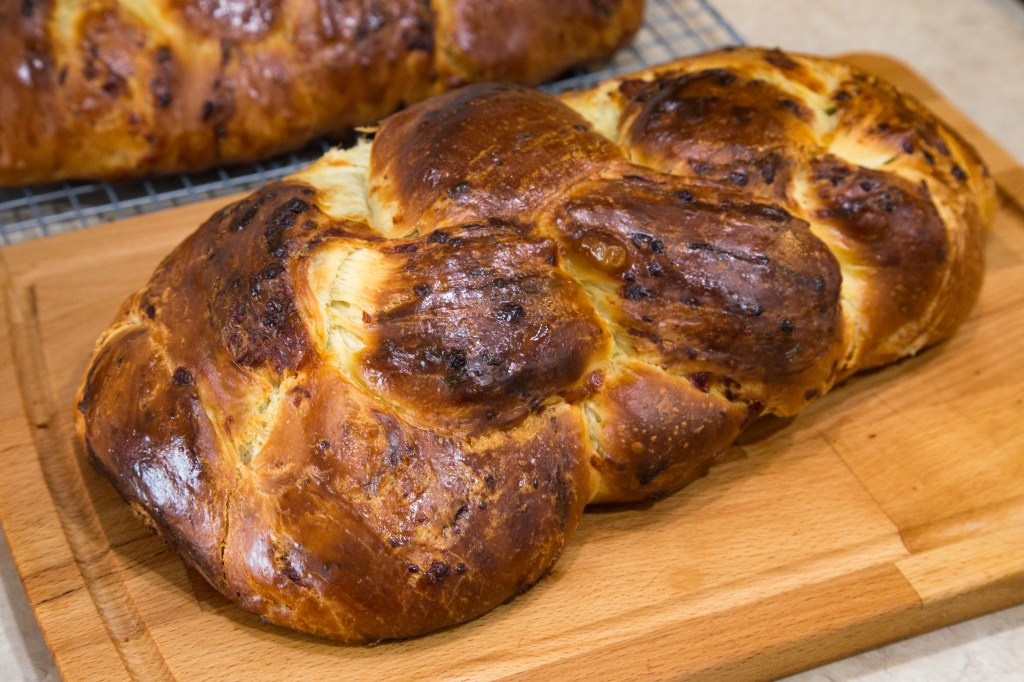
Warm, cheesy, fluffy, with a crunchy crust. The first time I had challah I realized it was the best bread I’ve ever eaten. Fresh out of the oven with good butter, nothing compares. This version kicks it up a notch with the addition of dubliner cheese and chives.
Recipe
Time: 1.5 hours, plus at least 3 hours resting
Yield: 2 generously sized loaves
Ingredients
For the Challah
- 3½ teaspoons (10.5g) active dry yeast
- 1 tablespoon plus ½ cup (100g) sugar
- ½ cup (118ml) vegetable oil, more for greasing bowl
- 5 large eggs
- 1tablespoon salt
- 8 to 8½ cups (960 to 1020g) all-purpose flour
For the filling
- 8oz (227g) shredded Dubliner cheese
- 1/4 cup (24g) chives
- 1/4 cup (57g) unsalted butter
Instructions
- In a large bowl, dissolve yeast and 1 tablespoon sugar in 1¾ cups lukewarm water.
- Whisk oil into yeast, then beat in 4 eggs, one at a time, with remaining sugar and salt. Gradually add flour.
- When dough holds together, it is ready for kneading. (You can also use a mixer with a dough hook for both mixing and kneading.)
- Turn dough onto a floured surface and knead until smooth, add more flour if needed. Dough should hold together, but will be tacky,
- Clean out bowl and grease it, then return dough to bowl. Cover with plastic wrap, and let rise in a warm place for 1 hour, until almost doubled in size. Dough may also rise in an oven that has been warmed to 150 degrees then turned off.
- Punch down dough, cover and let rise again in a warm place for another half-hour.
- To fill the loaves, divide the dough in half.
- Working with one half, pat the dough flat on a well floured work surface.
- Spread half of the melted butter over the dough and then sprinkle with cheese and chives.
- Roll the dough to encase the filling and cut the roll into 6 equal pieces.
- Form the pieces into loose balls to ensure the filling is enclosed.
- Roll each of the 6 pieces into snakes measuring about 12 inches long and slightly tapered at the ends. Line them up so they’re side by side and pinch together the ends of the strands to connect them at the top.
- Take the strand on the far right and cross it over the other strands, so it’s all the way on the far left side, placing it perpendicular to the other strands. Then, take the strand that was originally on the far left, and is now second from the left, and bring it all the way to the far right, also placing it perpendicularly.
- Fan out the remaining strands so there’s a generous space in the center. Take the strand on the far left and bring it to the center, but group it with the strands on the right. Next, bring the strand that’s second from the right and cross it over to the far left, also placing it perpendicular. Then, fan out the strands again, leaving a space in the center, and bring the strand on the far right to the center, grouping it with the strands on the left. Bring the strand second from the left to the far right and cross it over to the far left. Then, repeat this process until you’ve braided the entire length of the strands, tugging gently on the strands as you work to create tension in the braid.
- Pinch the ends of the braids and tuck them underneath the loaf, then transfer to a parchment-lined or lightly greased sheet pan. Make sure you have a couple of inches of clearance on either side of the braid so it can expand.
- Repeat steps 8 – 14 with the other half of dough.
- For a circular loaves, twist into a circle, pinching ends together.
- Beat remaining egg and brush it on loaves. Let rise another hour at room temperature.
- Towards the end of the rise, preheat oven to 375 degrees and brush loaves with the egg wash again.
- Bake in middle of oven for 35 to 40 minutes, or until golden and an internal temperature of 190 degrees. Cool loaves on a rack.
Tips and Tricks
If you want to make regular (unfilled) challah, skip steps 9 – 11.
If the 6 braid is too complicated, feel free to do a typical braid or even a two strand twist.
Other cheeses and spices could definitely be substitute for the types shown here.
Alternatively challah can be filled with raisins or topped with sesame or poppy seeds.
 Dib Bakes
Leave a comment